Mindful movement at Gilda’s Club
Before you continue reading, take a moment to pause and inhale. Hold it. And release. Now you’re ready for mindful movement at Gilda’s Club!
Healthy living classes are one of the pillars of the Gilda’s Club programs. Three of our regular classes – Qigong, Tai Chi, and Yoga – are rooted in mindful movement. And all three are led by incredible volunteers.
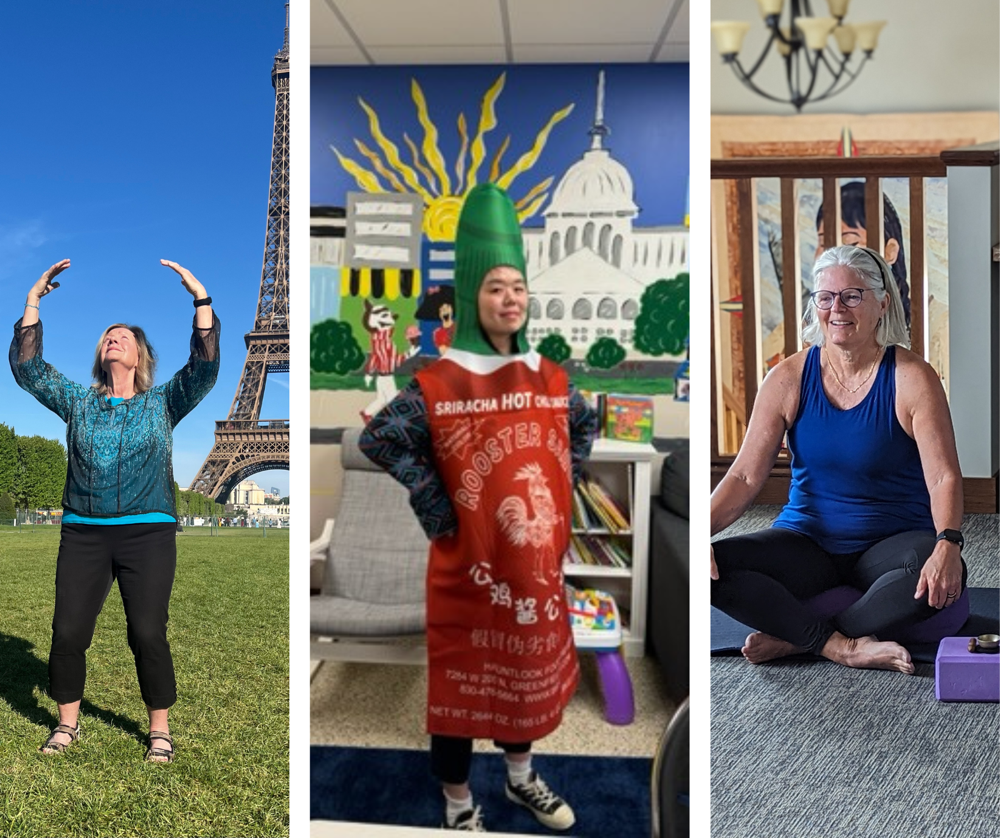
“This whole hour is to honor you and what your mind, body, and spirit needs,” explains Karen DuCharme, who leads “Gentle Yoga” each week. She became involved with Gilda’s Club back in 2013, as she was going through teacher training to become a yoga instructor. As part of her training, she had to come up with a program idea to reach a demographic that isn’t often served.
She connected with Gilda’s Club and shared her idea of yoga classes customized for the needs of those touched by cancer. Around that time, her sister had been diagnosed with lung cancer. She eventually became a caretaker to her sister in Florida, who unfortunately later passed away. Six months later, she lost her husband. The experience made her realize just how critical receiving emotional support is, both for caretakers and those with a cancer diagnosis.
“When I came back, it was the Gilda’s members who helped me heal. They are the strongest humans on the planet,” she explains. Karen has continued volunteering with Gilda’s Club ever since.
Bringing well-being to others
For Jing Cao, her connection to Gilda’s started as a part of her education. In the summer of 2020, Jing was looking for an internship as a part of her program in the Rehabilitation Psychology and Special Education department at the UW-Madison School of Education. “I had the opportunity to think about things I could do that would be interesting to the members,” Jing remembers.
She met with the Gilda’s staff and brainstormed ideas, before landing on the idea of virtual Tai Chi classes. They became the perfect way to build community during the pandemic, a time when community and connection were so desperately needed.
Similarly, Sandy Salvo was looking for a place to volunteer after she retired, and “Gilda’s seemed the perfect place to start,” she remembers. “Like almost everyone I know, we’ve had cancer touch our lives in a number of ways. My whole reason for doing this in the first place is to bring well-being to others. It seemed like the perfect fit.”
Sandy is a certified Qigong Instructor through the Institute of Integral Qigong and Tai Chi and a certified Mindfulness Meditation Teacher. She recently returned from a national Qigong conference, where she learned new practices and ideas that she’s excited to bring back to her class.
“Where the mind goes, the Qi will flow”
It might be helpful to take a moment to distinguish between Tai Chi, Qigong, and Yoga. While all three traditions share many similarities, there are some differences.
“There is a saying: ‘Where the mind goes, the Qi will flow,’” shares Sandy. With Qigong, “The ‘qi’ part is our life force. The ‘gong’ part means to play with it or to cultivate it in a healthy way.”
The practice includes four “baskets”: breathwork, flowing movements, self-massage, and meditation and mindfulness. Her 45-minute virtual classes incorporate all four, offering participants a well-rounded practice each time.
Living in a harmonious way
Tai Chi is closely related to Qigong, and both are rooted in Taoist philosophy. Jing describes Taoism as, “living in a harmonious way by respecting other living things.” Tai Chi is essentially a specific form of Qigong.
Jing’s classes are held weekly each Tuesday evening for 15 minutes. Baduanjin (Eight Pieces of Brocade or Eight Silken Movements) is one of the most common forms of Tai Chi exercise that serves to improve human health. A complete Baduanjin includes eight separate exercises, each addressing a different physical area and qi meridian. In traditional Chinese Medicine, meridians support the flow of qi and other fundamental substances in the body.
“It’s not just about the movement aspect,” Jing explains. “It’s also about the social and mental health aspect. It’s all interconnected.”
Grounded in your body
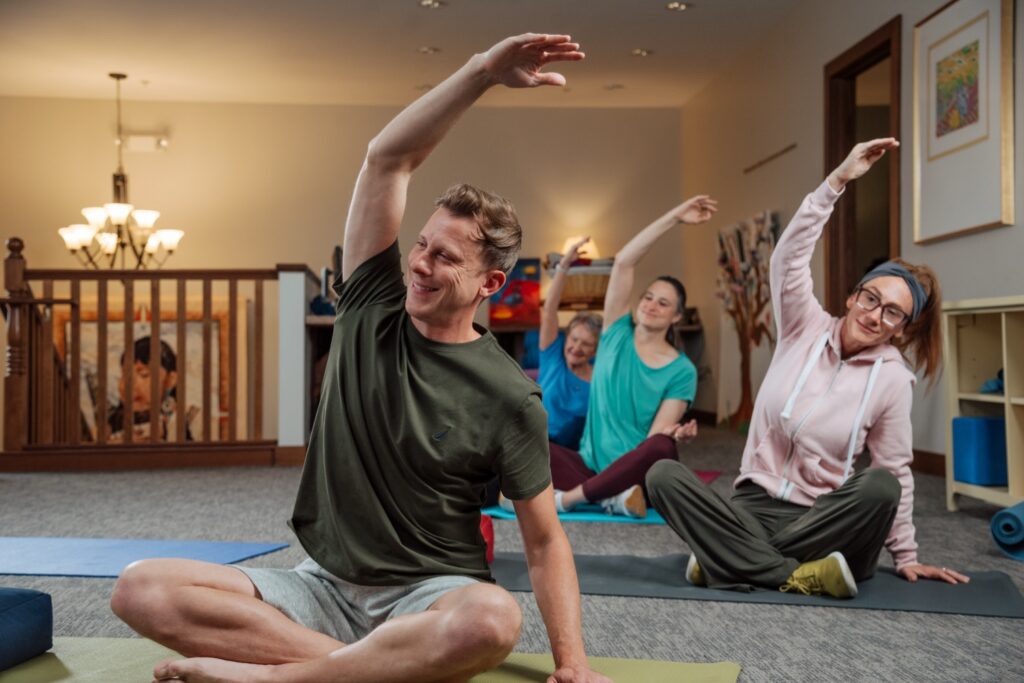
Yoga is rooted in traditions from the other side of the Himalayan Mountains. ‘Yoga’ means ‘union.’ “For me, it’s connecting your mind, body, and spirit,” shares Karen. “Being grounded in your body. Using the breath to regulate your nervous system. It’s really about how an individual connects with their health and their body.”
Karen’s classes are held weekly and are hybrid, so folks can decide if in-person or virtual works best for them. They can also switch between the two.
Three traditions, interconnected roots
There are many commonalities among the three practices, including an understanding of the interconnectedness of mind, body, and spirit, living harmoniously with the earth, and the importance of community. Each incorporates breathwork and imagery connected to nature.
Yoga, Tai Chi, and Qigong are also shown by research to improve physical and mental well-being, something particularly helpful to those with a cancer diagnosis and their caregivers. “I have found that for people with cancer, it’s not about doing, it’s about undoing,” explains Karen.
And, importantly, all three practices are accessible to all. The three classes are available virtually, so anyone across the state can access them, regardless of how they are feeling. And yoga is available in-person as well, for those who prefer to come to our Middleton clubhouse.
Beyond that, they are accessible to everyone regardless of physical limitations. “That’s what I really love about Qigong. Adaptations are actually encouraged,” Sandy shares. Karen regularly adapts yoga poses for those who have recently had surgery or have other physical limitations.
The importance of community
One theme shared by all three instructors is the importance of community. Karen points to the concept of sangha, or community, as especially meaningful for people with cancer. “People with cancer need that connection, knowing that they’re not alone,” she shares.
Jing agrees: “The best part of the group is that people keep contributing ideas. There is no stagnation. We keep sharing things that can be empowering to ourselves and others.”
And it’s the community aspect that keeps all three volunteers continuing their classes year after year.
Qigong, Tai Chi, and Yoga are three healthy living practices offered at no cost to anyone impacted by cancer, wherever they are in their cancer experience.
Karen shares, “I always tell them to give themselves permission to just be. And that’s enough.”
Thank you to Karen, Jing, and Sandy for being your amazing selves and for all that you bring to our members! If you’re interested in joining one or more of these classes, visit our program calendar at www.GildasClubWI.org/Calendar. These classes, like all of our programs, are offered at no cost thanks to the generosity of our community.